


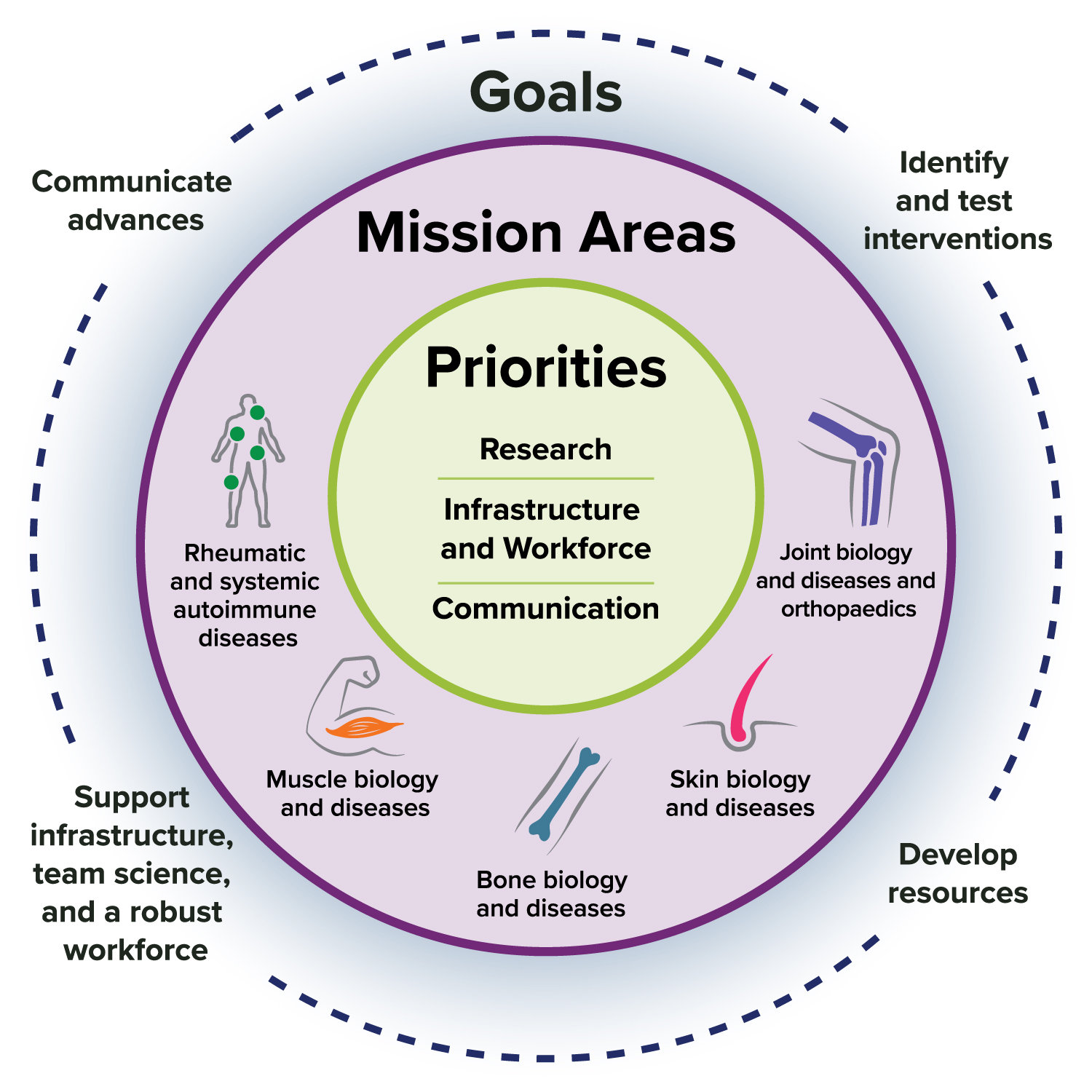
The NIAMS Strategic Plan for FYs 2025–2029 aims to foster an adaptable research environment that enables scientists to leverage opportunities available using today’s knowledge and technologies, and to stimulate research in new, transformative areas as they arise, to the ultimate end of enabling all people to live longer and healthier lives. It reflects considerable input from researchers, patients, and others who are interested in the NIAMS mission.
The Plan articulates four broad, adaptable goals that will allow the institute to pivot toward new research directions as they emerge over the next five years:
- Advancing therapy development for everyone by identifying human biological, behavioral, and environmental factors that affect health, disease, and the patient experience and testing interventions in people with arthritis, musculoskeletal, and skin diseases.
- Fostering discoveries to improve human health by developing resources, including relevant preclinical models, unbiased clinical data, and computational biology approaches.
- Supporting necessary infrastructure and a robust research workforce capable of conducting all types of studies, including interdisciplinary research and team science.
- Communicating timely and relevant advances to patients, communities, and scientists.
Ten stated priorities serve as guideposts and reflect themes that contributors identified as highly relevant to advancing research as it exists today. Priorities, strategies, and examples are included to provide additional granularity and guidance to those who might apply to NIAMS for funding or wish to partner with the institute to advance the fields of bone biology and diseases; joint biology and diseases and orthopaedics; muscle biology and diseases; rheumatic and systemic autoimmune diseases; and skin biology and diseases.
- Priority 1: Studying Molecular and Cellular Mechanisms of Health and Disease in Humans and Understanding the Resulting Phenotypes and Endotypes
- Priority 2: Developing Regenerative Medicine Approaches to Facilitate Repair or Restoration of Tissue
- Priority 3: Using Data Science, Artificial Intelligence and Machine Learning (AI/ML), and Computational Biology to Advance Knowledge and Treatments
- Priority 4: Understanding Behaviors and Environmental Exposures That Promote Health or Cause Disease
- Priority 5: Translating Findings Into Interventions Through Clinical and Epidemiologic Studies
- Priority 6: Conducting Research to Address Health Disparities
- Priority 7: Developing Enabling Research Infrastructure Including Technologies and Model Systems
- Priority 8: Supporting Interdisciplinary Research, Team Science, and Partnerships
- Priority 9: Promoting Training and a Robust Workforce
- Priority 10: Conducting Information Dissemination and Engagement Activities