Description
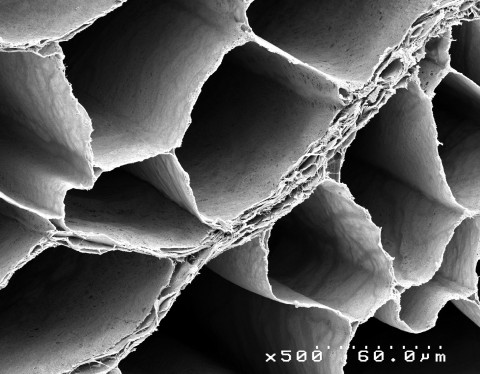
Composed primarily of collagen, connective tissue surrounds each individual muscle cell, creating a complex network. When an organism moves, the connective tissue helps transfer the force created by muscle cells to tendons and bones. This scanning electron microscopy image shows the connective tissue in a bullfrog’s leg muscle. The cells have been chemically digested away, leaving only collagen behind. Researchers are studying the structure of connective tissue from a variety of species to understand how it shapes muscle function. They also hope to learn how diseases that affect collagen structure influence muscle health. This photo was selected as a 2016 winner of the BioArt competition of the Federation of American Societies for Experimental Biology (FASEB).
Source
David Sleboda, B.S., Department of Ecology and Evolutionary Biology, Brown University (Thomas Roberts, Ph.D., vice chair)